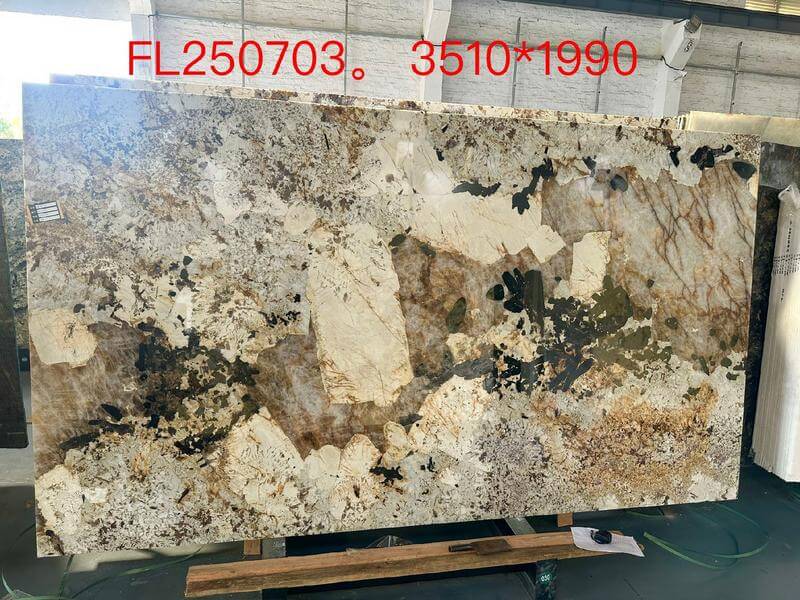
Patagonia quartzite is Brazil's most talked-about "statement stone" — a natural quartzite celebrated for its dramatic crystalline mosaic, where semi-translucent blocks of glassy quartz sit inside a warm mix of cream, beige, brown, and black minerals. Rated 6–7 on the Mohs scale, it delivers exotic looks with close-to-granite durability. One thing every buyer must know before ordering: because of its open crystal structure, most batches contain natural voids and fissures that are stabilized with resin filling, so the fill ratio is the single biggest quality variable of this stone.
Technical Specifications
| Property | Patagonia Quartzite |
|---|---|
| Stone Type | Natural quartzite (classified by some geologists as a quartzite–granite hybrid) |
| Origin | Brazil |
| Mohs Hardness | 6–7 (glassy quartz zones reach 7) |
| Water Absorption | 0.1–0.3% (varies with natural voids and fill level) |
| Density | 2.6–2.7 g/cm³ |
| Finishes | Polished, honed (leathered on request) |
| Slab Sizes | approx. 2000×1500mm up to 3100×1800mm; custom cutting available |
| Special Characteristics | Semi-translucent crystal blocks, cream/brown/black mineral mosaic, natural voids typically resin-filled |
| Sealing | Required at installation; reseal every 12 months |
Appearance: A Crystalline Mosaic
No two Patagonia slabs look alike. The stone reads like a fractured geode reassembled by hand: angular chunks of semi-translucent quartz catch the light and almost glow, while the surrounding matrix blends cream, caramel, chocolate, and jet-black minerals in a bold, terrazzo-like mosaic. Under direct light — or partial backlighting — the crystal blocks shimmer and give the surface genuine depth. Crystal size and color balance vary heavily from bundle to bundle: one slab can be dominated by large glassy crystals, the next finer and warmer. That is why slab-by-slab selection matters more with Patagonia than with almost any veined marble.
Best Applications
- Statement kitchen islands — the signature use; a single Patagonia island anchors the entire room
- Feature walls and TV backgrounds — ideally with partial LED backlighting to activate the translucent crystals
- Bar fronts and reception desks in hotels, retail, and hospitality projects
- Custom furniture — dining tables, consoles, and vanity tops
One honest caution: because the crystal zones contain natural voids and fissures that are usually resin-filled, Patagonia performs best on statement surfaces and vertical applications rather than heavily worked, cutting-intensive countertops. If you plan to use it as a working kitchen top, confirm the fill ratio and the fabrication plan with your fabricator first.
Buying Tips: Always Ask About the Resin Fill Ratio
Because resin filling defines how a Patagonia slab will look and age, use this checklist before ordering:
- Ask the fill ratio first. Well-selected slabs carry only light filling; heavily filled batches can look cloudy, dull the crystal sparkle, and age faster. Ask your supplier for an honest assessment of the exact slabs.
- Check that the fill is color-matched and polished flush with the crystal — visible fill lines or cloudy patches signal rushed fabrication.
- Confirm whether slabs are mesh-backed (common for open-crystal Patagonia) and that your fabricator has experience with this structure.
- Request wet and backlit photos/videos of the actual slabs, not reference images, so you can judge crystal size, fill, and color before committing.
- Match slabs for multi-slab projects — variation between bundles is significant and book-matching must be planned at selection stage.
Care & Maintenance Guide
- Clean daily with a pH-neutral stone cleaner or mild soap and a soft cloth. Never use vinegar, bleach, or abrasive pads — they dull the polish and damage resin-filled areas.
- Reseal once a year; honed or more heavily filled surfaces may need it sooner. If water stops beading and darkens the stone, it is time to reseal.
- Use trivets under hot cookware: the quartz itself handles heat well, but the resin fill can discolor under prolonged direct heat.
- Cut on boards, wipe spills (wine, citrus, oils) promptly, and avoid standing water around filled zones and voids.