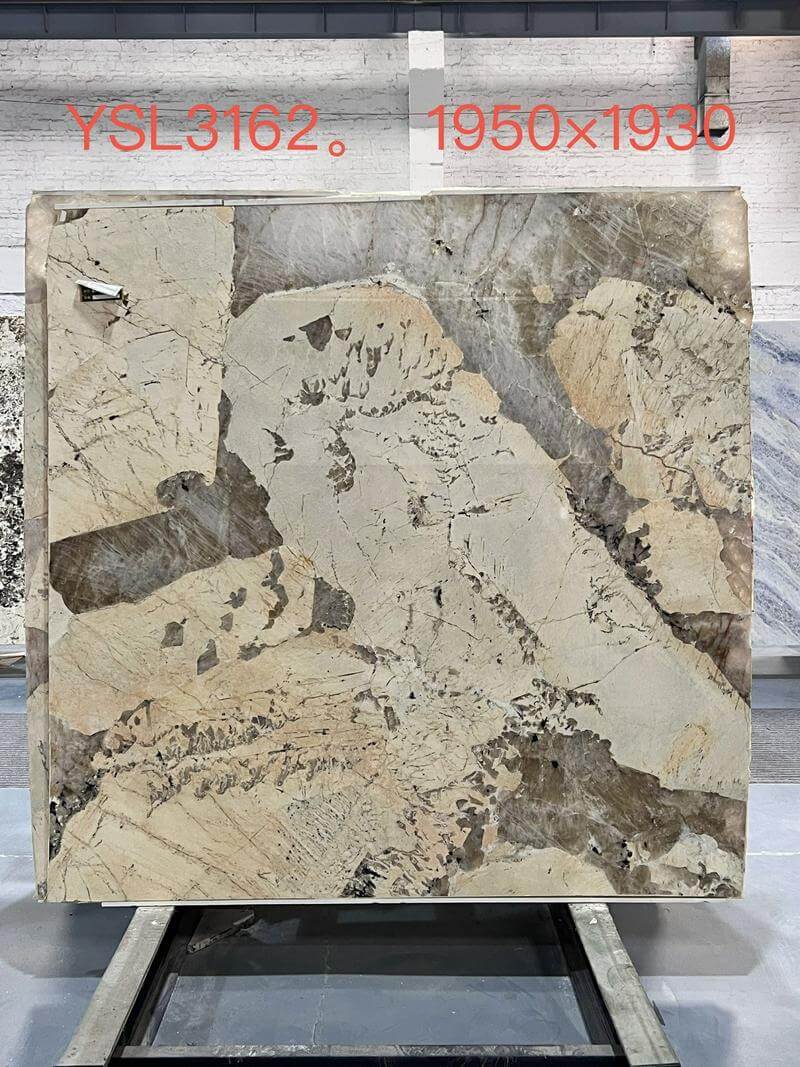
Pandora marble is an exotic Chinese marble celebrated for its splash-ink veining — bold white, cream, and grey-green strokes flowing across the slab like an ink-wash painting. As a natural marble it sits at Mohs 3–4 hardness, with water absorption of roughly 0.1–0.3% and density of 2.6–2.7 g/cm³, quarried and processed in China. Those numbers tell an honest story: Pandora is a stunning decorative stone, and it is a true marble — it will acid-etch, it needs sealing every 6–12 months, and it is not the right material for heavy-duty kitchen countertops.
Pandora Marble Specifications
| Parameter | Specification |
|---|---|
| Stone Type | Natural exotic marble (calcium carbonate) |
| Origin | China |
| Mohs Hardness | 3–4 (standard marble range) |
| Water Absorption | ≈0.1–0.3% |
| Density | ≈2.6–2.7 g/cm³ |
| Finishes | Polished, honed |
| Slab Sizes | 2000×1500mm, 2400×1600mm, custom cut-to-size |
| Acid Sensitivity | High — etches on contact with lemon, wine, vinegar |
| Sealing Frequency | Every 6–12 months |
Appearance: Splash-Ink Veining
What sets Pandora apart is texture: an animated, ink-splash movement rather than the fine cracks of Carrara or the clean gold veins of Calacatta. Creamy-white fields are torn by sweeping grey-green and deep charcoal strokes, often interwoven with translucent sugary patches. Vein direction and scale change dramatically from slab to slab — every slab is one of a kind, so we always share photos and videos of the exact stock slabs before you commit. For feature walls, bookmatched pairs turn the veining into mirrored artwork.
Where Pandora Works — and Where It Doesn't
Recommended applications: luxury dining tables (round and rectangular), feature walls and TV backgrounds, fireplace surrounds, bathroom vanities with light use, hotel lobby and commercial feature walls, and custom furniture. These are settings where Pandora's drama can be seen and where contact with acids and heavy abrasion is limited.
Not recommended: heavy-use kitchen countertops. As a genuine marble, Pandora will etch where lemon juice, wine, vinegar, or tomato land, and it scratches more easily than quartzite or granite. We would rather tell you this now than after installation. If you want a similar warm, artistic look for a working kitchen, Taj Mahal quartzite is the standard marble-look alternative with near-granite durability.
Care & Maintenance
- Sealing: apply a quality impregnating sealer every 6–12 months. Quick test — drop water on the surface; if it absorbs and darkens the stone within a few minutes instead of beading, it is time to reseal.
- Daily cleaning: pH-neutral stone cleaner or mild soap and a soft cloth only. Never use vinegar, lemon-based cleaners, bleach, or abrasive creams.
- Acid protection: use coasters under glasses, wipe spills immediately, and keep citrus, wine, and tomato off dining-table surfaces or use placemats.
- Etch repair: light etch marks on polished slabs can be buffed out and re-polished by a professional; honed finishes hide etching far better.
All slabs are available for custom cutting to your exact dimensions, with professional fabrication, edge profiling, and worldwide shipping in secure wooden crates. As a supplier based in Nanzhuang — the heart of China's luxury stone trade — we offer factory-direct pricing on genuine Pandora marble with full traceability.